
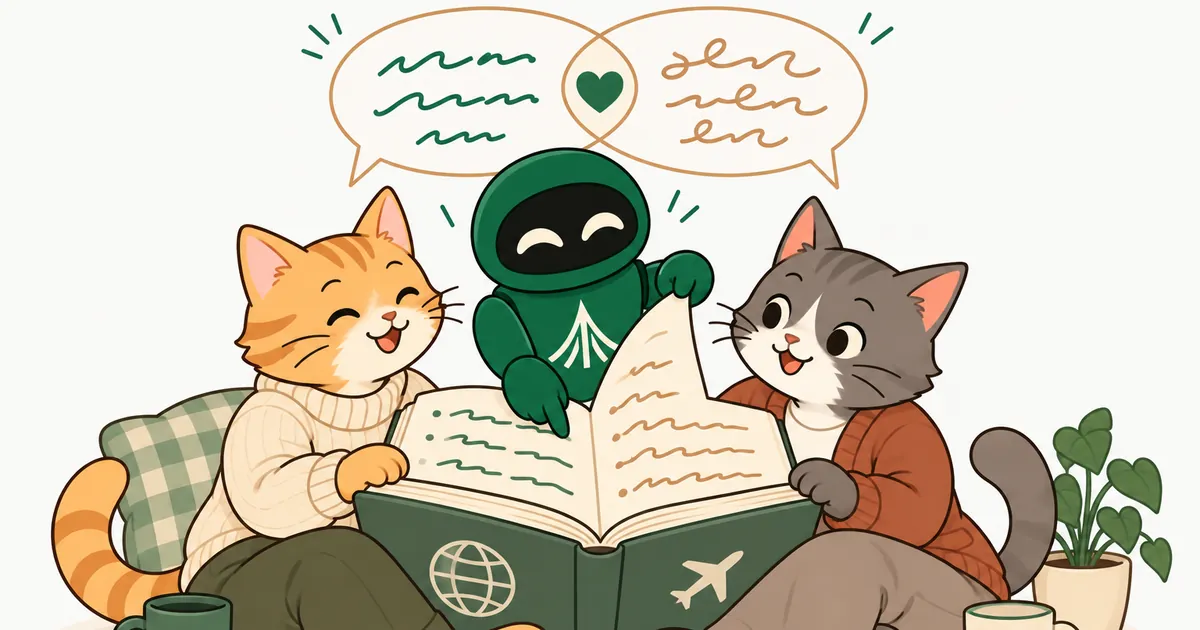
How the phrasebook works
Choose your language and your partner's. Each phrase is shown in their language, with a transliteration for Russian, Arabic and Japanese so you can say it before you can read the script, and the meaning in yours underneath. Tap the copy button to paste a phrase into a message.
The phrases cover the moments that matter most and go wrong most easily: saying sorry, reassuring, asking for space, setting a boundary, saying thank you and making up after an argument.
Why it matters in your partner's language
Many couples with two first languages run their relationship in one shared language, often one that is not either partner's first. That works well for everyday life. It works less well in an argument, when one person is searching for words while the other is fluent, or when an apology in a second language sounds flatter than it is meant.
People often say that emotional words in their first language land differently: "I'm sorry" in a language you learned at school can sound polite, while the same words in the language you grew up with can sound like you mean it. Learning a few of these phrases is a small gesture that tells your partner you have thought about how it feels on their side.
A few notes on the phrases
- They are casual. Spanish uses tú, French tu, Russian ты, Turkish sen, and Japanese plain forms, as you would with a partner. Brazilian Portuguese uses você, which is casual there.
- Some words change with gender. Where they do, both forms are given with a slash. The first is the one a man says or is told, the second the one a woman says or is told.
- Tone matters more than grammar. A phrase said warmly, with a mistake or two, does more than a perfect one said quickly.
- Ask your partner to teach you. Saying a phrase for them and asking how to say it better is a nice conversation in itself.
If you are also apart, the long-distance time-zone planner finds the hours you can talk. For the conversations no phrasebook covers, the hard conversation planner helps you start them.