
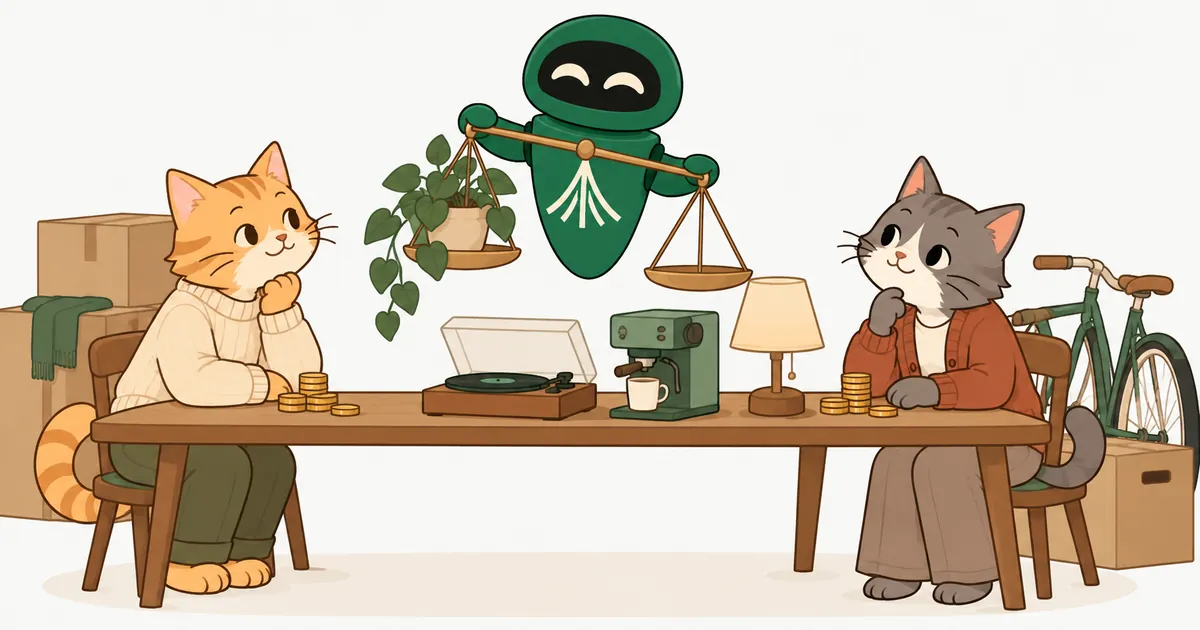
How the divider works
One of you lists the things you shared: furniture, the car, kitchen things, books, plants, accounts. Then each of you, separately, spends 100 points across that list, giving more points to what you want more. When you have both finished, the divider shows who takes what.
You can do it on one device, handing it over, or each on your own phone. On two phones, the list and the first person's points travel inside the link they send, and the second person spends their points before seeing anything. Nothing is sent to us.
The method: Adjusted Winner
The division uses Adjusted Winner, a fair-division procedure designed by the political scientist Steven Brams and the mathematician Alan Taylor. It works in two steps:
- Each item goes to whoever gave it more points. At this point one of you is usually ahead.
- Items move from whoever is ahead to the other person, starting with the ones the leader cares least about compared to the other, until you are level. If moving a whole item would overshoot, that one item is shared.
The result has three properties that are hard to get any other way. You both end up with the same score, each by your own points. Neither of you would rather have the other's share. And there is no other division that would make one of you better off without making the other worse off.
Using it well
- Be honest with your points. Putting points on something only to stop the other person getting it takes points away from what you actually want, and the method rewards honesty.
- Agree the list first. The second person cannot add items, so it helps to go over the list together before you start.
- Leave out what is not yours to divide. Property, savings, pensions and debts can have legal rules where you live. This is for belongings.
- Children are not on the list. For time with children, the co-parenting schedule maker shows how common arrangements look on a calendar.
- Pets are allowed, because people do divide them, but for a pet a shared arrangement is often kinder than a winner.
The shared item
If one item ends up shared, the divider gives you the fair proportion. One of you can buy the other out at that ratio, you can sell it and split the money the same way, or for something like a pet, you can share time in that proportion.
Separating is hard even when it is amicable. If you feel unsafe with your ex-partner, do not meet alone to hand things over. A domestic abuse service can help you plan that safely; Find A Helpline lists free, confidential ones in your country.